1. Order Intake and Allocation Engine
Orders pass from e-commerce shopping engines through an application interface into the warehouse management queue. The system reviews total available physical stock, evaluates pending carrier cut-off times, and compiles orders into picking waves. Wave generation prevents warehouse gridlock by grouping orders that share common warehouse aisles or specific carrier collection slots.
2. Comparative Picking Methodologies
Different catalog profiles demand distinct retrieval approaches. Applying single-order picking to a high-volume cosmetics retailer produces excessive operator footsteps and bottlenecked aisles.
| Picking Strategy | Process Structure | Optimal Order Profile | Operational Limitations |
|---|---|---|---|
| Discrete Single-Order | One picker collects all items for a single customer shipment. | Low order volume or oversized, bulky merchandise. | High travel distance per item picked; inefficient for multi-item carts. |
| Batch Picking | Picker gathers identical SKUs for multiple orders on a single trip. | Promotional flash sales with low SKU diversity and high order counts. | Requires secondary sorting step at sortation tables prior to packing. |
| Zone Picking | Pickers remain within assigned aisles and pick only local items. | Large warehouses with broad catalogs spanning multiple product types. | Orders must be consolidated across zones before reaching pack benches. |
| Wave Picking | Orders grouped by time slots, carrier collection schedules, or delivery zones. | Facilities operating under rigid parcel locker carrier dispatch deadlines. | Requires strict software supervision to prevent release of incomplete waves. |
3. Packing Station Engineering and Ergonomics
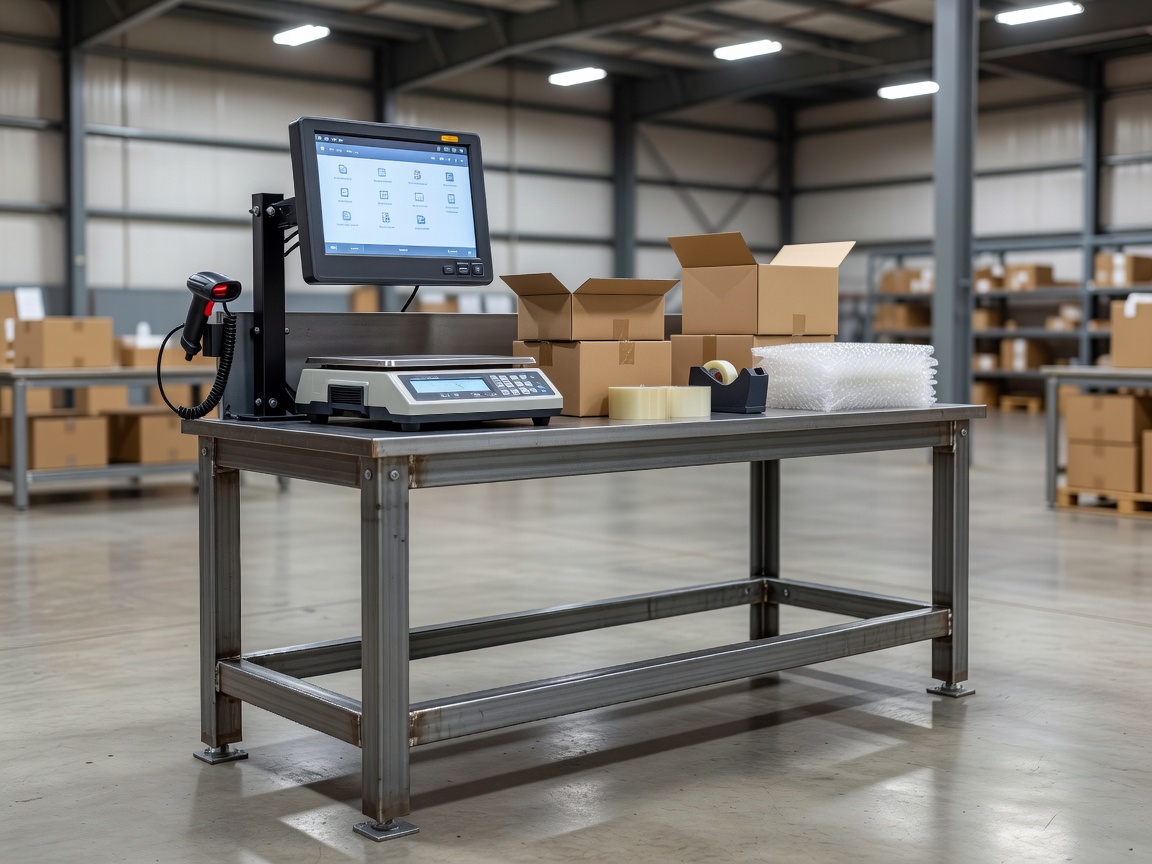
The packing bench is the final quality assurance gate before parcels leave warehouse control. An efficient packing station incorporates:
- Overhead Carton Storage: Tiered racks holding standard box formats (Boxes 01 through 06) within arm's reach of the packer.
- Hands-Free Scanners: Table-mounted omnidirectional laser scanners allowing operators to scan products using both hands.
- Inline Scale Integration: Integrated scale platforms connected directly to the shipping software. If an order weighs 1,240 grams but the theoretical weight of the items plus box is 1,600 grams, the terminal halts labeling and prompts visual re-inspection.
- Dunnage Dispensation: Air-cushion or kraft paper dispensers suspended above the bench to eliminate bend-and-lift motion fatigue.
4. Cartonization and Volumetric Parcel Control
Baltic regional carriers impose strict volumetric dimensional weight pricing and compartment restrictions on parcel locker deliveries. Software cartonization calculates total cubic displacement of ordered items and specifies the exact carton size code on the packer display.
Correct carton selection avoids empty void space inside shipping containers, reduces dunnage consumption, and prevents carriers from levying volumetric oversize surcharges.
5. Dispatch Staging and Label Generation
Once packed and taped, the shipping label is generated instantly using high-speed direct thermal printers. The label contains:
- Carrier routing barcode (Code 128 or GS1 DataMatrix)
- Specific automated parcel locker ID or residential delivery code
- Outbound sorting terminal lane number
Parcels drop directly from packing stations into mobile rolling cages pre-assigned to distinct carrier linehaul routes.